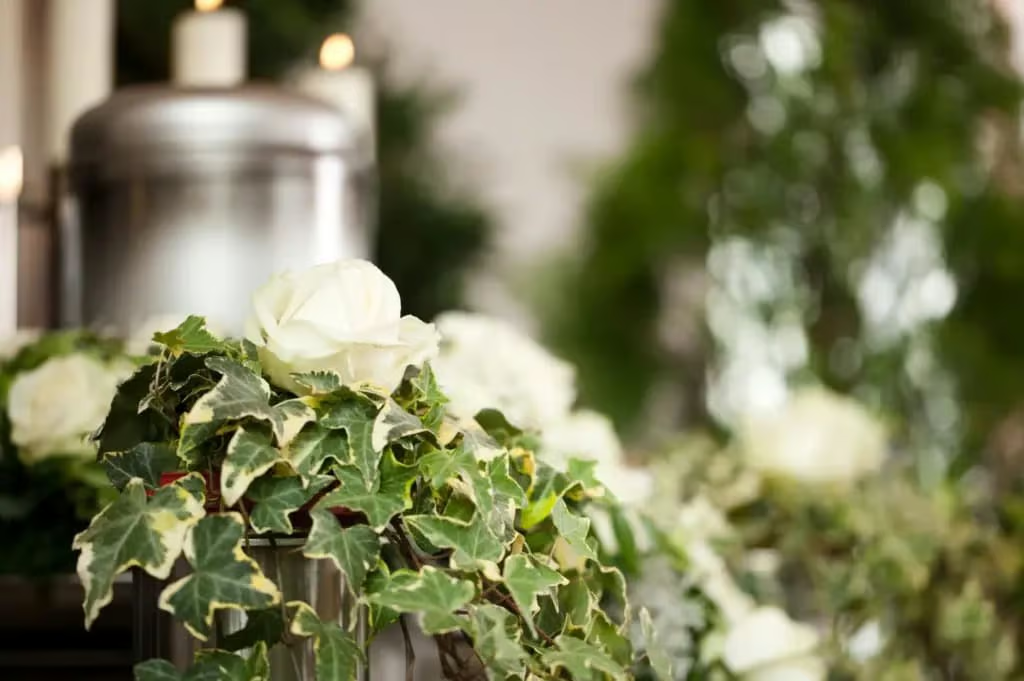
Yes, Catholics can be cremated. The Church lifted its ban in 1963 and today permits cremation unless it is chosen to deny belief in the resurrection (Catechism 2301). Burial is still preferred. If a family chooses cremation, the ashes should be kept in a sacred place, such as a cemetery or columbarium, and not scattered, divided, or kept at home. The question comes up more every year: the NFDA projects a US cremation rate of 63.4% in 2025, rising to 82.3% by 2045.
Catholic Cremation Rules: What Is Allowed and What Is Not
Allowed
Cremation, when it is not chosen for reasons contrary to Christian faith.
A funeral Mass with the body present, followed by cremation (the Church’s preference).
In the US, a funeral Mass with the cremated remains present, if the diocesan bishop permits (USCCB).
Burial or entombment of the ashes in a cemetery, mausoleum, or columbarium.
Since December 2023, the ashes of several people may be kept together in a defined, permanent sacred place, with each person identified by name.
Since December 2023, with the approval of church authority, a family may keep a minimal part of the ashes in a place significant to the person who died, as long as the rest of the ashes are kept in a sacred place.
Not allowed
Scattering the ashes “in the air, on land, at sea or in some other way.”
Dividing the ashes among family members.
Keeping the ashes in “mementos, pieces of jewelry or other objects.”
Keeping the ashes at home, except in grave and exceptional cases the local bishop allows.
A Catholic funeral is denied when a person publicly requested cremation and scattering for reasons contrary to the faith.
Why the Church’s View Changed
The Church once forbade cremation because early advocates promoted it as a rejection of the resurrection. As that link faded, the Church moved to permit cremation while keeping rules that protect respect for the body. The timeline below shows each step.
In 2023 the Vatican clarified its rules on keeping ashes. Cardinal Matteo Zuppi of Bologna asked the Vatican two questions about cremated remains. The Dicastery for the Doctrine of the Faith answered on December 9, 2023, with Pope Francis’s approval: ashes of several people may be kept together in a defined, permanent sacred place, and church authority may allow a family to keep a small portion in a place meaningful to the person who died. This change marks a significant push for reform and reflects the changing attitudes of today. Discover how the Vatican’s stance on the practice of cremation has changed over the centuries.
Vatican’s View on Cremation: 1886
Cremation grew greatly in popularity during the 19th century as an acceptable funeral custom largely due to the concern for hygiene, conservation of land and the rise of aesthetic views.
Towards the end of the 19th century, the Church officially condemned the practice of cremation in 1886, in response to its early proponents who specifically saw cremation as a way of denying the Christian teachings of life after death and the resurrection of the body.
Vatican’s View on Cremation: 1917
The Church’s 1886 rejection of cremation was further reinforced in the 1917 Code of Canon Law, the law which governs the Church’s way of life. The law (no 1203) forbade cremation and stated that anyone cremated must be denied a church funeral, except in instances of public necessity like natural disasters or during dangerous infection outbreaks.
Vatican’s View on Cremation: 1963
After decades of debate, the first move toward permitting cremation came on July 5, 1963, when the Vatican’s Holy Office (now the Dicastery for the Doctrine of the Faith) issued the instruction Piam et Constantem.
The instruction asked that the custom of reverently burying the faithful be preserved, but it said cremation is not “opposed per se to the Christian religion.” Catholics who chose cremation would no longer be denied the sacraments and funeral rites, unless the choice came from a denial of Christian teaching, membership in a secret society, or hatred of the Church.
This was a change in Church discipline, not doctrine. The preference for burial remained, but cremation was no longer forbidden. The Church later wrote the change into the 1983 Code of Canon Law (as summarized by the Vatican in 2016).
Vatican’s View on Cremation: 1983
The Vatican’s permission to allow for cremation was incorporated into the revised Code of Canon Law of 1983 (Canon # 1176), as well as into the Order of Christian Funerals. It then became standard practice to celebrate the funeral liturgies with the body and then take the body to the crematorium.
Vatican’s View on Cremation: 1997
In 1997, the Congregation for Divine Worship and the Discipline of the Sacraments granted an indult for the United States to allow the diocesan bishop to permit the presence of the cremated remains of a body at a Funeral Mass.
Later that year the Congregation confirmed the special texts and ritual directives, which were then published as an appendix to the Order of Christian Funerals. The Order of Christian Funerals’ Appendix on Cremation stated:
“Although cremation is now permitted by the Church, it does not enjoy the same value as burial of the body. The Church clearly prefers and urges that the body of the deceased be present for the funeral rites, since the presence of the human body better expresses the values which the Church affirms in those rites.”
The preference at this time, was if a family choose cremation, the cremation would take place at some time after the Funeral Mass, so that there could be an opportunity for the Vigil for the Deceased in the presence of the body (during “visitation” or “viewing” at a church or funeral home).
Vatican’s View on Cremation: 2016
On August 15, 2016, the Congregation for the Doctrine of the Faith published the instruction Ad resurgendum cum Christo (“To rise with Christ”), approved by Pope Francis and signed by Cardinal Gerhard Müller. It responded to the growing number of cremations and set out the first detailed rules on what to do with the ashes.
Cremation itself. The instruction says the Church has no doctrinal objection to cremation, because it does not affect the soul or prevent God from raising the body. Burial is still preferred as the clearer sign of faith in the resurrection. Cremation is not prohibited unless it is chosen for reasons contrary to Christian doctrine.
Where ashes go. Ashes must be laid to rest in a sacred place, such as a cemetery, or in some cases a church or an area set aside by church authority. This keeps the person in the prayers and memory of family and community, and keeps their remains from being forgotten or treated without respect.
What is not allowed.
- Keeping ashes at home. Only in grave and exceptional cases can the local bishop, together with the bishops’ conference, permit it.
- Dividing ashes among family members.
- Scattering ashes “in the air, on land, at sea or in some other way,” or keeping them in mementos, jewelry or other objects. The stated reason is to avoid any appearance of pantheism, naturalism or nihilism.
Funerals. A Christian funeral is denied only when the person publicly asked for cremation and scattering for reasons contrary to the Christian faith.
Vatican’s View on Cremation: 2023
In a letter dated October 30, 2023, Cardinal Matteo Zuppi, Archbishop of Bologna, asked the Vatican two questions. His archdiocese had formed a commission to respond to the growing number of people who wanted to cremate their loved ones and scatter the ashes in nature.
The Dicastery for the Doctrine of the Faith replied in a note signed by Cardinal Víctor Manuel Fernández and approved by Pope Francis on December 9, 2023. It reaffirmed the 2016 rule that ashes be kept in a sacred place, and allowed two things:
- Shared resting places. A defined, permanent sacred place may be set aside where the ashes of several baptized people are kept together, with each person identified “so as not to lose the memory of their names.”
- A small portion in a meaningful place. Church authority may consider a family’s request to keep a minimal part of the ashes in a place significant to the person who died, as long as civil law allows it, any pantheistic or naturalistic meaning is ruled out, and the rest of the ashes are kept in a sacred place.
Cardinal Zuppi said in his letter, dated Oct. 30, that his archdiocese had been seeking “to give a Christian response to problems arising from the increasing number of people desiring to cremate the bodies of the deceased and scatter their ashes in nature.”
Frequently Asked Questions
Can Catholics keep ashes at home?
No, except in grave and exceptional cases the local bishop allows. Since 2023, church authority may let a family keep part in a meaningful place while the rest are laid to rest in a sacred place.
Can Catholics scatter ashes?
Since 2023, ashes of several people may be kept together in a sacred place, and church authority may allow a small portion to be kept in a place meaningful to the person who died.
Is cremation a sin for Catholics?
No, unless it is chosen to reject belief in the resurrection. See Is cremation a sin?
Can you have a funeral mass with cremated remains?
In the US, yes, with the diocesan bishop’s permission. The Church still prefers the body to be present, with cremation afterward.
What does Pope Leo XIV say about cremation?
As of October 2026, Pope Leo XIV has not issued new guidance on cremation, so the 2016 instruction and the December 2023 clarification remain the current rules.
What This Means for You
Today, the Catholic Church permits cremation unless it is chosen for reasons contrary to Christian teaching., although it still recommends traditional burials when possible (canon 1176). However, with burial space becoming increasingly scarce and costly, many families find themselves exploring cremation.
Catholic families considering a Memorial Forest should talk with their parish or diocese about how it fits Church guidance on resting places for ashes.
Remembered Respectfully
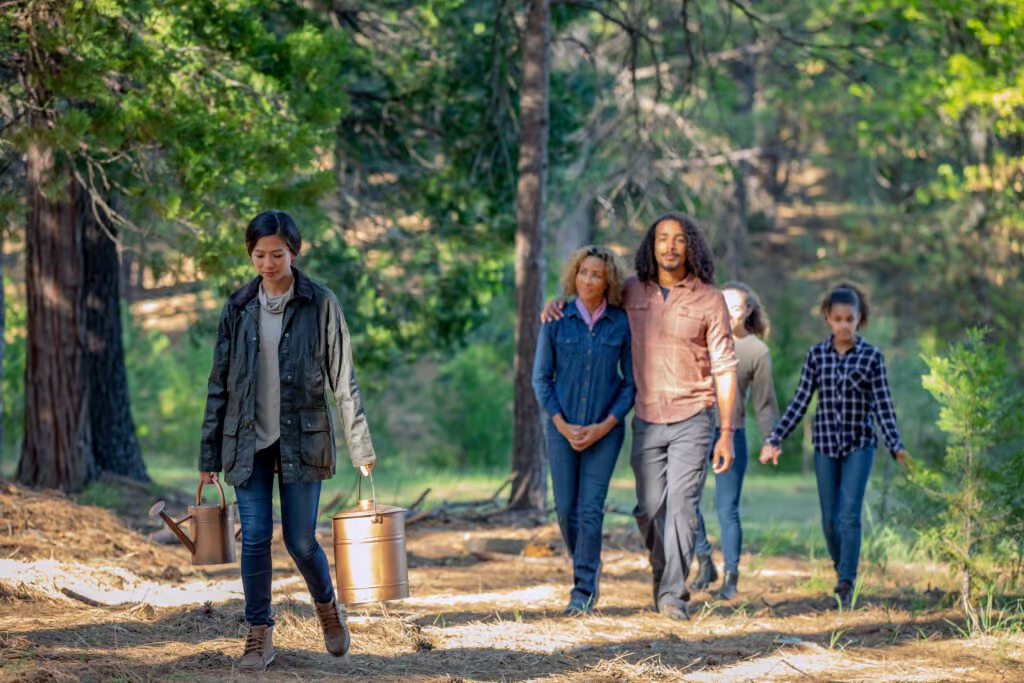
Many of our Catholic customers find solace in the tranquility of a Memorial Forest. They feel closer to God in nature, appreciating the chance to be laid to rest at the base of a dedicated Memorial Tree in a protected Memorial Forest.
Better Place Nature Memorial Ceremonies are conducted in beautiful, natural settings, offering a peaceful and intimate experience. The ceremony can be customized to reflect your spiritual preference around your private Memorial Tree, and a Memorial Marker will mark the location, providing a place for loved ones to visit and honor your loved one’s legacy and memory.
Planning Your Legacy
Choosing Better Place Forests promises a protected Memorial Tree that stands as a living tribute for generations to come. If you have questions, we are here to guide families of different faiths. Whether starting your end-of-life plans or ready to reserve your Memorial Tree, our team is here to help. Book a free online consultation and begin planning a meaningful legacy that aligns with your values and vision. Start Here