Planting a tree in memory creates a living tribute that grows for years to come. This guide compares every option from a young sapling to a mature Memorial Tree, so you can choose a lasting, visitable tribute that fits your loved one (or pet). If you’re looking for a heartfelt way to honor the memory of a lost loved one, planting a tree in memory is one of the most meaningful paths families choose. A living tribute lets their legacy keep growing, and there’s real healing power in staying close to nature while grieving.
What is a Memorial Tree Planting?
Planting a tree in memory can mean a few different things. It could mean planting a tree in memory of a loved one through a nonprofit like the Arbor Day Foundation, or planting a sapling somewhere close to their heart—a backyard, a favorite trail, a family property. It could also mean joining an already-established tree at a protected Memorial Forest, where cremated remains are returned to the soil at the base of a mature tree.
There’s an important difference between these paths, and it’s worth knowing before you choose. Planting your own sapling means years of watering, protecting, and hoping it survives disease, weather, and neglect—with no guarantee it makes it to adulthood.
A Memorial Tree with Better Place skips that uncertainty entirely: your tree is already decades old, already thriving, and already part of a forest that’s professionally stewarded, forever. No planting. No waiting. No risk that the memorial itself doesn’t survive.
Where can you plant a tree in memory of someone?
There are four realistic places, and they are not interchangeable.
A national forest, through a reforestation nonprofit
Organizations including the Arbor Day Foundation and the National Forest Foundation plant trees in national forests that need restoring, on your behalf, starting around $60. You are funding a planting in a managed forest. There is no specific tree assigned to you and no location to visit.
Your own property
A backyard, a family property, a place that meant something. You control the species and the spot, and you carry the risk: the sapling has to survive, and the memorial only lasts as long as your family owns the land.
A city park, street, or cemetery
Many municipalities and cemeteries run tree dedication programs, usually with a plaque and a maintenance term. Costs vary enormously by city and can reach four figures. Availability is limited and waitlists are common, so start with the city’s parks department or the cemetery office rather than a national vendor.
A protected Memorial Forest
Rather than planting, you reserve a specific mature tree that already stands in a protected forest and return ashes to the soil at its base. The tree is identified, the location is recorded, and you can visit it. Better Place Memorial Forests run from the Berkshires in Massachusetts to Yosemite Gateway in California.
What you cannot do
You cannot plant a memorial tree wherever you like. Public land, national and state parks, and roadside verges all have their own permit rules, and cemeteries set planting rules independent of state law. If you are burying or scattering ashes at the tree, that is a separate set of rules again. Confirm with the specific site before you buy anything.
Can you plant a tree in memory of a pet?
Yes. Every option above works for pets as well as people: reforestation nonprofits accept dedications in a pet’s name, and a sapling in the yard is a common choice for a family dog or cat. At a Better Place Memorial Forest, pets can share the family’s tree or rest at a tree of their own, so the whole family ends up in one place.
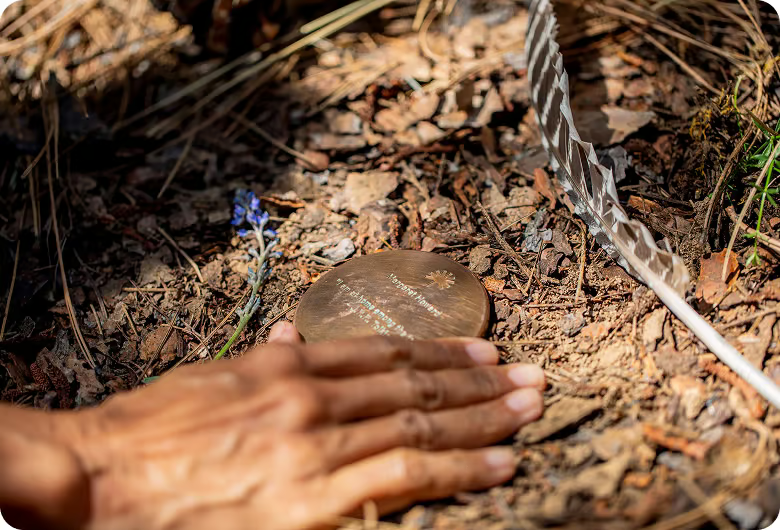
If you want a marked spot, pair the tree with a plaque. City dedication programs usually include one, and at Better Place a bronze Memorial Marker at the base of the tree carries names, dates, and your words.
Are Memorial Tree services legitimate?
Most are, but “legitimate” covers three different products and it is worth knowing which one you are buying. A reforestation donation funds planting somewhere in a managed forest—real trees, no specific tree that is yours. A gift sapling is a real tree shipped to you, roughly 12 inches tall, and whether it survives is down to you. A reserved tree with Better Place is a specific, already-mature tree in a protected forest, identified and stewarded for you.
The questions worth asking any provider: can you tell me where this tree stands, can I visit it, what happens if it dies, and is that commitment in writing? A service that cannot answer the first two is selling a donation, which is fine—as long as that is what you wanted.
Symbolism involved with trees
Trees carry deep symbolic meaning across cultures: an oak for strength, a maple for change, an evergreen for endurance. Choosing a species can be a way of reflecting who your loved one was. For the full species-by-species guide, see our article on tree symbolism and meanings.
At a Better Place Memorial Forest, that choice isn’t limited to what you can plant and hope survives in your own yard. You can choose from mature trees already established across protected forests nationwide, from redwood coastline to New England ridgetops, and find the species and setting that feels right.
Which tree suits which person
There is no correct answer, only a fitting one. A few that families return to:
Oak — strength and endurance. The most-chosen memorial species, and the one most often planted in national forests for exactly that reason.
Maple — change and passage. Often chosen for someone who moved through several lives in one.
Evergreen and pine — continuity. They do not drop their leaves, which for some families is the entire point.
Willow — grief itself, openly. An old choice, and an honest one.
Redwood — scale and time. Chosen when a normal lifespan feels like the wrong unit of measure.
If you are planting yourself, the constraint is climate before symbolism — the right species in the wrong zone is a dead tree in three years. If you are reserving a mature tree, that constraint is already resolved: every tree in a Better Place forest is native to where it stands, from redwood coastline to New England ridgetops.
Memorial Tree vs. planting a tree yourself: how they compare
When considering ways to memorialize a loved one, traditional choices like headstones or markers have long been the default. But more families are looking for something living. Here’s why a Memorial Tree, and specifically a mature, protected one, tends to win out:
| MEMORIAL TREES | PLANTING A TREE |
| Mature, established trees Your memorial is part of a healthy, thriving tree already decades old. | Vulnerable saplings Newly planted young trees require years of care to survive. |
| Widely available nationwide Memorial Forest locations coast to coast. | Legal restrictions Most places don’t allow burying ashes and planting a tree wherever you like. |
| Guaranteed longevity Proven, healthy trees with strong root systems and established growth. | High failure risk Saplings can die from disease, weather, pests, or lack of maintenance. |
| Immediate environmental impact Your tree is already absorbing CO2 and supporting ecosystems today. | Delayed environmental impact Takes years before a young tree provides meaningful environmental benefits. |
Environmental Aspect
Preservation of Forest Lands: A Memorial Tree helps preserve forest that might otherwise face development, rather than requiring new land to be cleared or planted.
Immediate carbon impact: A sapling takes years before it meaningfully absorbs carbon or supports wildlife. A mature Better Place tree is already doing both, today.
Biodiversity support: Established forests support wildlife corridors and at-risk species in ways a single newly planted tree can’t yet.
Emotional Aspect
Living Memorials: Trees endure as living symbols of a life, but only if they survive. A mature tree removes that uncertainty from the equation entirely.
Healing Through Nature: Protected Memorial Forests offer a genuine place to return to, walk, and sit with grief — not just a plot to visit.
Giving Back: Supporting stewardship of protected land is a way of giving something back, on behalf of the person you’re remembering.
Choosing the Right Memorial Tree: Factors to Consider
Choosing a tree with Better Place is a thoughtful decision, and the questions families naturally ask about longevity, location, personalization, and upkeep are worth walking through carefully:
- Longevity: A sapling’s lifespan depends entirely on species and how well it’s cared for over years, with real risk it doesn’t make it to maturity. A Better Place Tree is already decades old and established, so the “will it last” question is already answered.
- Location Preferences: Rather than being limited to a backyard or a single nonprofit planting site, Better Place offers protected forests across the country — from the Berkshires in Massachusetts to Yosemite Gateway in California—so you can choose a setting that matches a loved one’s favorite kind of place.
- Personal Connections: A Memorial Tree isn’t limited to one person. You can reserve a tree for yourself, for a spouse, for your whole family, and add pets over time—turning it into a living, shared monument rather than a single planting.
- Climatic Suitability: A sapling planted in the wrong climate can struggle or fail outright. Every native tree in a Better Place Forest is already thriving in its natural setting, so there’s nothing to get wrong.
- Maintenance: A backyard or personally planted tree depends on you (or whoever inherits the property) to keep it alive for decades. Better Place forests are professionally stewarded — ecologically monitored and trail-maintained — so the tree, and the memory it holds, is cared for long after you are.
Whichever path feels right, the choice is yours. If you’d like to plant a tree yourself, the resources above can help guide that process. And if you’d rather skip the uncertainty and simply return your loved one’s ashes to an already-thriving, protected tree, a Better Place Guide can walk you through choosing one—no obligation, just a conversation.
What does it cost to plant a tree in memory of someone?
Between $60 and $6,200, depending entirely on which path you take. A reforestation donation sits at the bottom of that range and a reserved mature tree at the top, and they are not the same purchase.
A reforestation donation has flexible pricing. Nonprofits like the Arbor Day Foundation A reforestation donation has flexible pricing. Nonprofits like the Arbor Day Foundation plant trees on your behalf in national forests that need restoring, starting at around $60, and send a dedication certificate. You are funding a planting, not reserving a tree — there is no specific tree or location to visit to honor the memory of a loved one.
A memorial gift tree — a sapling shipped to the family to plant themselves — typically runs $65–$180 depending on species and packaging. It’s important to note that these saplings are usually only about 12 inches tall and require significant care to take root, grow, and thrive. It will only survive if it’s planted well and tended to consistently. It could take up to 15 years for the sapling to start looking like a real tree, and 50–100 years to look like a mature tree.
A city or cemetery tree dedication varies enormously by municipality, and can reach four figures where a plaque and long-term maintenance are included. Availability is limited and waitlists are common.
A Tree with Better Place is a different kind of purchase: you are reserving a specific mature tree in a protected forest, with irrevocable access rights and professional stewardship in perpetuity, rather than buying a planting. Trees start at $6,200 and you can add people and pets to your tree across generations.
Planting a tree in memory of someone is a beautiful gesture. But grief already asks enough of us. A tree lets you honor someone today—not hope a sapling survives them.
FAQs
What happens if a Memorial Tree dies?
With a sapling you planted yourself, nothing happens—there is no guarantee and no replacement. With a nonprofit reforestation gift, individual tree loss is expected and absorbed into the forest as a whole.
At Better Place, we know that the forest’s cycle of life and death are interconnected. If your tree dies before any ashes have been spread, we’ll help transfer you to another tree free of charge. If your tree dies after ashes have been spread, your Memorial Marker(s) will remain, marking your special place in the forest ecosystem. We look at each tree on a case-by-case basis, and we seek to be minimally invasive while prioritizing forest health.
What do you say when you plant a tree in memory?
There is no set script, and short is better than polished. Most families say four things: their name, the date, why this tree, and one specific memory — not a summary of the person, one actual moment.
If you want a line to open with, families most often use some version of: ‘We are planting this tree for [name], so that something they loved keeps growing.’ Then the memory. Then their name again. Thirty seconds is enough; people remember the pause more than the words.
When you scatter ashes at a tree with Better Place our Guides will help you find the right words by helping you select reading, poems, and more to create a personalized memorial ceremony in nature that reflects the person you love.
What do you do at a tree dedication ceremony?
Families gather to honor and reflect on the person who’s gone, often planting or visiting a living memorial together. At a tree with Better Place, a Guide can help shape a personalized Nature Memorial Ceremony around your family’s own traditions and wishes.
What does “plant a tree” mean on an obituary?
When an obituary says ‘in lieu of flowers, please plant a tree’ or ‘memorial contributions may be made to plant a tree,’ the family is asking you to skip the arrangement and fund a tree instead. It usually means one of two things: a donation to a reforestation nonprofit in the person’s name, or a contribution toward a tree the family is reserving or planting themselves.
If the obituary names an organization, use it. If it does not, a reforestation gift in their name from any reputable nonprofit meets the request, and sending the family the dedication certificate is the part that matters to them.
What do you write in a tree dedication card?
Keep it to three or four sentences: what they meant to you, one specific memory rather than a general sentiment, and why you chose a tree for them. Naming the species and where it stands gives the family something concrete to hold on to.